Developed Applications
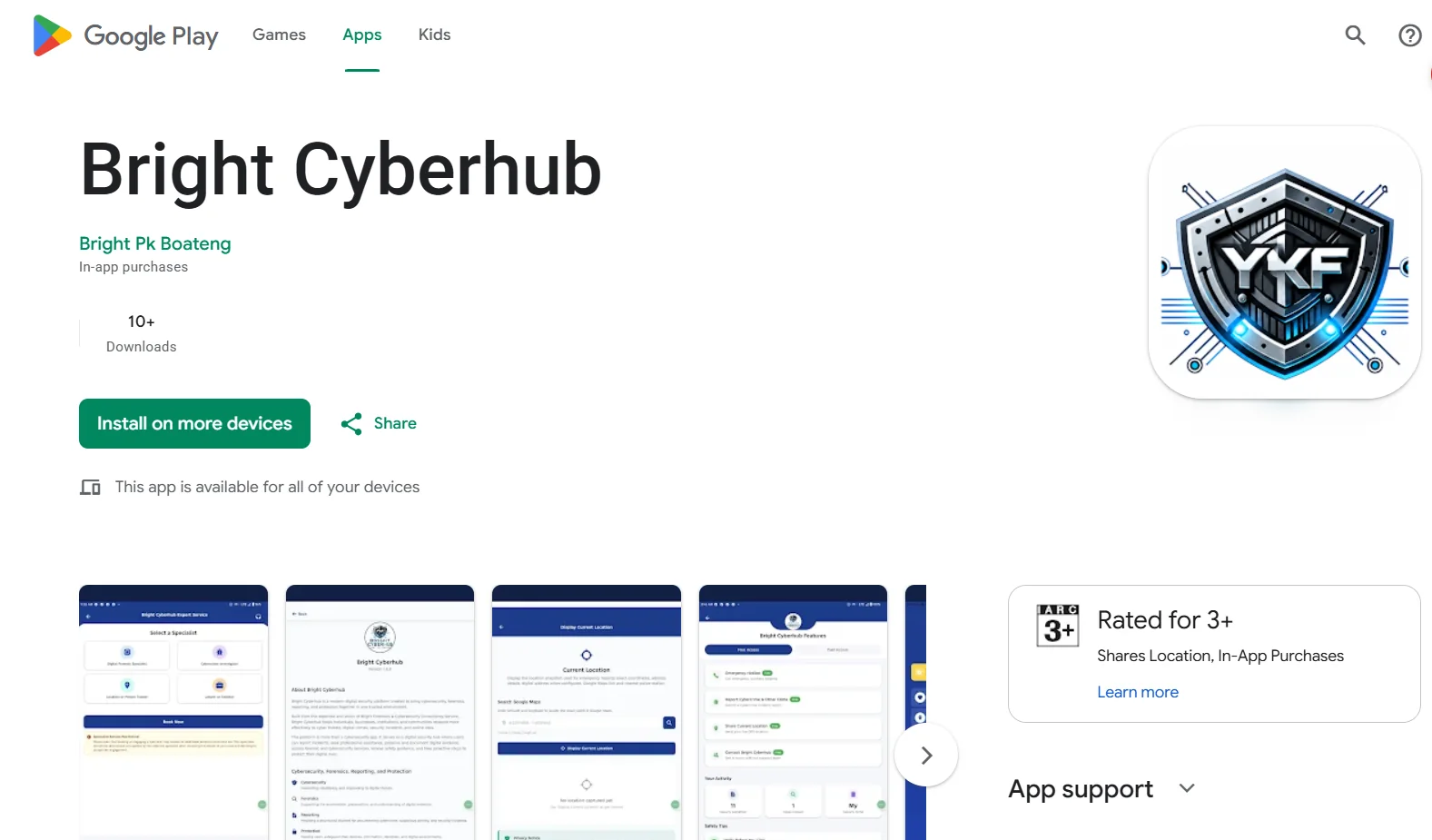
Bright Cyberhub - Integrated Cybercrime Reporting, Digital Safety & Emergency Response Platform
Bright Cyberhub is an innovative, integrated cybersecurity and digital public safety platform that I designed and developed to bridge the gap between cybercrime victims, digital forensic professionals, law enforcement resources, and essential emergency assistance services. Developed as an Android mobile application, the platform brings together cybercrime reporting, digital evidence submission, emergency support, location sharing, professional cybersecurity assistance, and digital safety education within a single accessible environment.
The application provides a structured reporting system through which individuals can document incidents involving online fraud, hacking, impersonation, cyber harassment, threats, sextortion, and other cyber-enabled offences. Users can provide incident details, identify affected platforms, submit supporting information, and access reporting and case-tracking functions.
Bright Cyberhub also incorporates emergency communication tools, GPS location sharing, and a police station locator designed to help users identify nearby police facilities, obtain directions, and access available contact channels. Its emergency support features are intended to assis
Bright Cyberhub - Integrated Cybercrime Reporting, Digital Safety and Emergency Assistance Platform
Project Overview:
Bright Cyberhub is a multifunctional cybersecurity, digital forensics, cybercrime reporting, and public safety mobile application that I conceived, designed, and developed to address challenges associated with cybercrime victimisation, incident reporting, access to professional investigative services, and emergency assistance.
The platform was developed to provide individuals, businesses, communities, and cybersecurity professionals with a centralised digital environment for reporting incidents, accessing digital safety information, requesting specialised assistance, and locating relevant emergency services.
Bright Cyberhub reflects my professional experience as a Cybercrime and Digital Forensics Investigator with the Ghana Police Service, my educational background in Computer Science, and my commitment to improving digital safety awareness and access to victim-centred cybercrime reporting services.
Project Motivation and Problem Identification:
Cybercrime continues to affect individuals, businesses, educational institutions, and communities through online fraud, impersonation, hacking, financial scams, cyber harassment, sextortion, and other technology-enabled offences.
Many victims experience difficulties identifying appropriate reporting channels, documenting evidence, obtaining professional assistance, or determining what actions to take immediately after an incident.
Some victims delay reporting because they are uncertain about available support services, fear embarrassment, or lack sufficient knowledge of digital evidence preservation.
Emergency situations also create challenges when individuals cannot easily communicate their location or identify nearby security services.
I developed Bright Cyberhub to address these problems by integrating incident reporting, specialist assistance, location-based safety features, and digital awareness resources into one mobile application.
Core Features and Functional Capabilities:
1. Cybercrime and Other Crime Reporting
Bright Cyberhub provides a structured reporting interface that enables users to document cybercrime and other security incidents.
The reporting form captures relevant information, including the complainant's contact details, the incident date and time, the affected platform, the incident category, the location, and a description of the circumstances.
The reporting workflow is designed to improve the completeness and organisation of information submitted for subsequent review.
2. Digital Evidence Documentation
The platform is designed to support the collection and submission of relevant information and digital evidence associated with reported incidents.
Its wider reporting workflow includes supporting materials such as screenshots, images, documents, videos, and audio recordings, with the corresponding attachment functions enabled.
This feature is intended to encourage early documentation and help victims retain information relevant to subsequent investigative assessment.
3. Emergency Assistance and Communication
Bright Cyberhub incorporates emergency support functions that provide access to emergency contact numbers and location-sharing tools.
The application displays Ghana's police emergency hotline, 191, and provides shortcuts intended to help users seek assistance during urgent situations.
These functions are designed to complement established emergency response channels rather than replace direct contact with the appropriate authorities.
4. GPS Location Sharing and Monitoring
The application provides a location-sharing function that enables users to share GPS coordinates from their mobile devices.
A specialist service module also presents location monitoring for authorised support scenarios.
These tools are intended to assist with communicating a user's location during emergencies or other circumstances requiring consent-based location sharing.
5. Police Station Locator and Directory
Bright Cyberhub incorporates a searchable police station directory with a location-based discovery interface.
The screenshots show a station directory containing 326 entries, including police stations across Ghana.
Users can search for stations by name, area, region, or division and access available information such as station names, locations, directions, telephone contact options, and messaging shortcuts.
A nearest-station feature is designed to use the device's GPS location to assist users in identifying nearby facilities.
6. Access to Cybersecurity and Investigative Specialists
The application includes a Select a Specialist workspace that organises professional services into relevant categories.
The visible categories include:
Digital Forensics Examiners.
Cybercrime Investigators.
OSINT and Location Tracking Specialists.
Lawyers and Solicitors.
Video and Image Forensics Analysts.
Security Systems and Physical Security Specialists.
The aim is to make it easier for users to identify an appropriate type of professional assistance for cyber incidents, evidence examination, legal concerns, and physical security needs.
7. Telecommunications Records and Itemised Bill Analysis
The platform includes an Itemised Bill Analyzer service option.
This component is designed to support the analysis of authorised telecommunications records in formats such as photographs, PDF documents, and Excel files.
The service description highlights extraction of cell-site information, frequently contacted numbers, and location-related telecommunications indicators.
Telecommunications-derived locations are approximate network observations and should not be treated as precise device coordinates.
8. Phone Number Verification and Lookup
Bright Cyberhub includes a Number Lookup feature intended to assist with basic phone-number verification, including country, mobile network, and line-type information.
Its interface also describes additional authorised caller-information and scam-reporting capabilities, subject to data availability, consent, and access restrictions.
This service is intended to support safer digital communication and appropriate investigative enquiries without providing unrestricted access to private subscriber information.
9. Cybersecurity Awareness and Prevention
Beyond incident reporting, the platform promotes preventive cybersecurity education.
Its interface includes practical safety guidance, such as encouraging users to verify links and sender identities before opening messages.
This educational component supports the wider objective of reducing preventable online victimisation through accessible digital safety information.
10. User Dashboard and Activity Monitoring
Bright Cyberhub provides an activity dashboard containing sections for submitted reports, tracked cases, and the user's reporting portal.
These functions are designed to help users access their reporting history and follow up on submitted incidents.
11. Free and Premium Access
The application separates essential free features from premium professional services.
The visible free-access section includes emergency hotline access, crime reporting, location sharing, and support contact options.
The premium-access model is designed to support specialised services while keeping basic public safety and reporting functions accessible.
Software Architecture and Development:
Bright Cyberhub is developed as an Android mobile application using React Native and Expo, with a supporting backend built around Node.js, Express, Prisma, PostgreSQL, and JWT-based authentication.
The wider platform also includes administrative and service-management components supported by a Next.js dashboard, Railway deployment infrastructure, and third-party service integrations.
The development approach combines mobile interface design, backend API development, database management, user authentication, report processing, and integration of location-aware services.
My Role and Technical Contributions:
I served as the Founder, Software Developer, Product Designer, and Technical Lead of the Bright Cyberhub project.
My contributions included identifying user needs, conceptualising the application, designing reporting and support workflows, developing its mobile interface and supporting systems, integrating the specialist service categories, and guiding the development of its emergency and location-based features.
My professional experience in cybercrime investigation and digital forensic examination influenced the application's emphasis on structured incident reporting, evidence documentation, victim assistance, and responsible handling of sensitive information.
The project also draws upon my work in cybersecurity awareness, digital safety advocacy, and community education through the Young Cyber Knights Foundation.
Innovation and Distinctive Contributions:
Bright Cyberhub is designed to connect multiple elements of digital safety and incident response that users would otherwise need to access separately.
Its distinguishing contribution is the combination of victim-centred incident reporting, cybersecurity education, specialist service discovery, emergency communication, location sharing, and investigative support within one mobile platform.
The application also addresses practical needs within Ghana by providing locally relevant police station information, emergency assistance resources, and specialist categories aligned with common cybercrime and security concerns.
Privacy, Security and Responsible Use:
Because cybercrime reports and location-sharing functions may involve sensitive personal information, privacy and controlled access are essential design considerations.
The platform is intended to support authenticated access, appropriate handling of submitted evidence, consent-based location sharing, and restricted use of specialist investigative services.
Specialist analysis, location monitoring, and subscriber-information requests must be conducted within applicable legal and authorisation requirements.
The application does not independently guarantee an emergency response, a successful criminal investigation, or direct access to restricted law enforcement databases.
Project Status and Future Development:
Bright Cyberhub has reached the Android application stage, with visible interfaces for reporting, emergency assistance, specialist selection, police station discovery, and user activity.
The project is undergoing continued development and enhancement, with attention to reporting reliability, evidence handling, case tracking, security, performance, user experience, and integration of specialist services.
Its ongoing development provides opportunities to strengthen privacy controls, accessibility, investigative workflows, and service delivery.
Professional and Research Significance:
Bright Cyberhub demonstrates my practical work across mobile software engineering, cybersecurity, secure reporting systems, digital forensics, emergency support technology, and human-centred application design.
It also aligns with my research interests in victim-centred cybercrime reporting, secure digital evidence submission, online safety, privacy, and the usability of investigative technologies.
The project illustrates my ability to translate professional experience and community needs into a digital product designed to address real-world problems.
Ultimately, Bright Cyberhub reflects my commitment to developing accessible, responsible, and socially relevant cybersecurity technology that strengthens digital safety awareness, improves access to reporting channels, and supports victims and communities in Ghana and beyond.